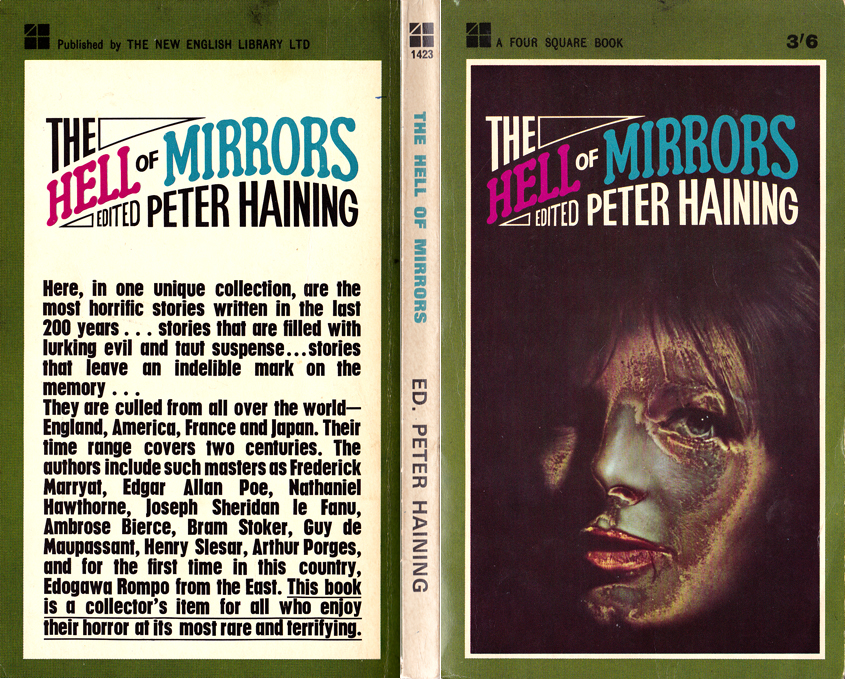
The Hell of Mirrors, 1965, Four Square (ed. Peter Haining)

After getting all new-fangled in my last post I thought I’d retreat back to my comfort zone again. We know we’re in a safe pair of hands with Peter Haining so let’s go with the young Mr. Haining’s second anthology The Hell of Mirrors (no, that’s not a misprint but more of that later).

Four Square books had some great cover designs and this one’s no exception. I particularly like that title bar, which was so good they printed it on the back cover too.

hell of mirrors

As Haining states in his brief introduction, this anthology contains stories covering two centuries and five countries.

C O N T E N T S

The Werewolf – Frederick Marryat

Ligeia – Edgar Allan Poe

The Black Cat – Edgar Allan Poe

Young Goodman Brown – Nathaniel Hawthorne

Schalken the Painter – J. S. Le Fanu

The Middle Toe of the Right Foot – Ambrose Bierce

The Damned Thing – Ambrose Bierce

The Squaw – Bram Stoker

Who Knows? – Guy de Maupassant

The Drowned Man – Guy de Maupassant

The Caterpillar – Edogawa Rampo

The Hell of Mirrors – Edogawa Rampo

The Knocking in the Castle – Henry Slesar

The Fanatic – Arthur Porges


Lets skim through the contents then. Among others, Haining  gives us a duo of de Maupassants, a brace of Bierces and a pair of Poes, but what we really want to be talking about here are the two tales from Edogawa Rampo.

Edogawa Rampo is the nom-de-plume of the Japanese author and translator, Tarō Hirai (1894-1965). He’s still not that well known in the West but he’s considered a master of the genre in his own country. Being a huge fan of Western horror and mystery fiction, particularly the works of Edgar Allan Poe, he took the decision to write under the name of Edogawa Rampo as a Japanese rendering of Poe’s name (…go on, say Edogawa Rampo in a Japanese accent and see how it sounds, you know you want to!).

Aside from his horror tales he also wrote Detective fiction, creating the first popular Japanese detective, Kogoro Akechi. Rampo was also a fan and translator of Arthur Conan Doyle and his detective is based upon Sherlock Holmes.

But we’re concentrating on his horror tales. They were first translated into English in the mid-1950s under a collection called, keeping to the Poe theme, Japanese Tales of Mystery and Imagination. The two stories we have here are from that collection and I believe this is the first time Rampo was anthologised in the West. Interestingly, he died in 1965, the same year as this publication so whether it was something to do with publication rights opening up or not, I don’t know.

Rampo’s tales are among the creepiest and memorable I have read. There’s something quite wonderfully distasteful about them. Thematically, these works fall into the category which gained popularity in 1920’s Japan, ‘Ero guro nansensu’. This is another Japanese rendering of English words, Erotic Grotesque Nonsense. As you can imagine one of the main themes is sexual abnormality.

The first tale, The Caterpillar, concerns a military veteran invalided out of the army due to the severity of his injuries. He has lost both arms and both legs, his face is completely disfigured, he has no hearing and cannot speak. He is the caterpillar of the title. His wife looks after him in a lonely house in the grounds of her husband’s commanding officer’s mansion. No one visits and the unkempt gardens are overgrown and full of snakes and abandoned wells. The story deals with the wife’s loneliness, fantasies, guilt and mental decline. This story was banned in Japan in the run-up to WW2 as it was thought it to cast the Japanese military in a poor light.

The second tale, from which the anthology takes its title, is The Hell of Mirrors. Rampo seems to have somewhat of an obsession with lenses, mirrors and optics as they feature in many of his earlier stories. Let’s hope he was never quite as obsessed as the protagonist of this story whom we follow from childhood and witness as his insanity grows along with his obsession. His experiments become more and more outrageous; starting from the building of his first telescope which, of course, he uses to spy through his neighbour’s windows, we’re taken on a wild and psychedelic journey through his deviances which, of course, end in disaster.

An unexpected parcel

For this post we’re taking a bit of a break from the horror fiction.

Some of you may remember that a couple of months ago I received a strange package through my letterbox, I wrote about it here:

The Shadow Over Soddenham

Well, reality slipped again this morning and I received another, slightly larger, unexpected parcel. All wrapped up in brown paper and tied with string, with a quote from Confucius in place of the usual postage stamp. This had to be from the good folks at Soddenham, Norfolk.

s1

s2

s3

I carefully placed it on the table (after listening to it to make sure it wasn’t ticking) and gently teased open the knot in the string. As the brown paper unfolded I was confronted with, what I thought at first to be, a beautiful handbound notebook with an oxblood cover. A paper label adorned the cover bearing the Soddenham crest.

s4

Along with this was a beautifully typed letter from, no less than, the chairman of the Soddenham Historical Society and Curry Club himself, Mr. Les Taret!

On opening the notebook I discovered that – no, it wasn’t a notebook at all! but a beautifully made presentation case containing samples of genuine Soddenham lichen, one piece of Extra Virgin, pre-harvest lichen (still on the branch) and another of pure ground lichen powder in a tiny glass phial.

s5

s6

s7

Perhaps I should explain a little about the importance of lichen to the economic history of Soddenham. Soddenham was once a major centre for lichen farming in the UK, their lichen orchards were famed for the quality of their produce and they exported it all over the Empire for the manufacture of spume. You can read more about it on this fascinating article on the Soddenham website here:

Lichen and The Decline of Spume

Sadly, due to the decline of the spume industry, Soddenham now has only one lichen orchard left, which is also the last one in England, as attested by the accompanying Certificate of Authenticity.

s8

In conclusion, I would just like to say a huge thankyou to Mr Taret and the other members of the SHSACC, Mssrs. Pardow, Drewery, Dengue and Thule and to the treasurer, Ms. Smokepipe. Also to Mr. Furcleby, the last remaining lichen husbandman. Thankyou all, I shall treasure this artifact; myself and Mrs Nash may well brush off our old Pashley tandem this summer and take a trip across to visit your wonderful village to experience the orchard for ourselves.

Best British Horror 2014, Salt (Ed. Johnny Mains)

This is a bit of a departure for me, I rarely read anything written past the mid-20th century (hence this blog). There’s no real reason for this particular quirk, it’s not that I think modern fiction is of poorer quality than the older, it’s probably just something to do with the fact that there’s already more books published than I could ever read in a lifetime anyway and, as time is at a premium, why take the chance with the newer stuff?

However, I was given this book as a Christmas present. I eyed it warily. The cover image is not exactly to my taste with its Texas Chainsaw Massacre-esque Leatherface type of character looking grimly into the middle-distance.

I then noticed the editor, Johnny Mains, and my interest was piqued a little. I’d heard of Mains from his passionate work with the reissuing of the first of the Pan Horror series.

My eyes then scanned down the cover to the publisher, Salt! A very well respected independent publisher, I already own several volumes from Salt as they were one of the finest publishers of poetry (another passion of mine). Notice I say ‘were’, they surprisingly stopped publishing single author collections of poetry last year (…actually, perhaps not so surprisingly as poetry is a notoriously poor seller).

Next I opened the book onto a random page, curious and a little worried as to what I was going to find among these new and exciting authors. And the first page I opened it on was…

Ramsey Campbell!

“Ok”, I thought, “…so things haven’t changed all that much since the ‘70s then!” But on flicking through the contents page I only noticed one other name I recognised, Tanith Lee. Actually, two names including Muriel Gray but I only knew her from her stint on The Tube back in the ‘80s.

I must admit that, from the cover, I was expecting pages dripping with gore and torture-porn; I’m not of a fan of this sub-genre of horror, rather than finding it disturbing or shocking I always find it tedious and juvenile. But, hands up, I’m very happy to say that I completely misjudged the situation with this publication. It is a mixed bag, obviously, and I’d be lying if I said that I liked all of the stories included; but there are enough stories here that are really quite outstanding to win me over.

best british horror 2014

C O N T E N T S

When Charlie Sleeps – Laura Mauro

Exploding Raphaelesque Heads – Ian Hunter

The Bloody Tower – Anna Taborska

Behind the Doors – Ramsey Campbell

The Secondary Host – John Llewellyn Probert

The Garscube Creative Writing Group – Muriel Gray

Biofeedback – Gary Fry

Doll Hands – Adam Nevill

Guinea Pig Girl – Thana Niveau

Touch Me With Your Cold, Hard Fingers – Elizabeth Stott

Dad Dancing – Kate Farrell

The Arse-Licker – Stephen Volk

Doll Re Mi – Tanith Lee

Laudate Dominium – D.P. Watt

Someone to Watch Over You – Marie O’Regan

Namesake – V.H. Leslie

Come Into My Parlour – Reggie Oliver

The Red Door – Mark Morris

Author of The Death – Michael Marshall Smith

The Magician Kelso Dennett – Stephen Volk

That Tiny Flutter of the Heart I Used to Call Love – Robert Shearman

Without a Mind – Joel Lane

My favourite of the bunch is the opening tale When Charlie Sleeps by Laura Mauro. Surprisingly, looking through the contributor bios, Mauro is one of the less established authors in the list; but, going by this story, she has a sound literary future ahead of her. I think one of the most difficult things for an author to tackle is the balance between ambiguity and plot and Mauro manages it very well here. I love a bit of ambiguity in a story when done well (eg. Robert Aickman, Shirley Jackson, Joyce Carol Oates, etc), it pulls the reader in and gives them a sense of conspiratorial inclusion.

This anthology has opened my eyes to a new world of horror literature in the 21st Century and I genuinely hope it will be an annual event, I’ll certainly be buying it if it is. I even took out a 12 month subscription to one of the magazines mentioned in the author bios, Black Static. I’m converted.

Look at me being all modern and that.

Christopher Lee’s ‘X’ Certificate, Star, 1975 (ed. Christopher Lee and Michel Parry)

It’s easy to dismiss these celebrity linked anthologies as populist tat cashing in on a star turn to shift a few units, but it would be a shame to overlook them as this one’s a corker and worth the cover price just for Christopher Lee’s introduction alone.

Lee tells us that he (probably more than ably assisted by Michel Parry, a famed horror anthologist himself) chose the stories in this collection as they all have “…the personal appeal of reminding me of some aspect or another of my career as an actor.”

What follows in his introduction is the most brilliant series of name-drops you’re likely to read and best read with Lee’s sonorous tones in mind:

Take for instance, The Spider by Fritz Lieber, an author I had the pleasure of meeting in Hollywood.

Or…

…The Man with the Golden Gun in which I played Scaramanga. The creator of 007 was, of course, the late Ian Fleming and one of the stories which I have selected was written by Ian’s brother, Peter. Incidentally, it is not generally known that I was distantly related to both Ian and Peter, they were my step-cousins.

Or…

Curiously enough, I once actually met Conrad Veidt  when I was a young boy. Apparently he was a keen golfer (like me) and I was introduced to him on a golf-course back in 1938 or 1939.


christopher lee's x certificate


C O N T E N TS

Introduction – Christopher Lee

The Spider – Fritz Leiber

I, The Vampire – Henry Kuttner

Talent – Robert Bloch

Amber Print – Basil Copper

The Gorgon – Clark Ashton Smith

The Kill – Peter Fleming

Blood Son – Richard Matheson

The Black Stone – Robert E. Howard

The Monster-Maker – W. C. Morrow

The Judge’s House – Bram Stoker


The Spider – Fritz Leiber

This story, which is possibly a comment against the juvenilisation of the genre, begins with a trio of people on a city street on a winter’s night. We do not know who they are, Leiber enigmatically refers to them as The Beautiful People. We have The Old Man with a hawk like face, grey hair and a black overcoat with an astrakhan collar; The Other Man with his collar pulled up, his brimmed hat pulled down, dark glasses, thick gloves and a strange accent; The Woman has a ‘slim queenliness’ in her black evening gown and velvet cloak.

Lee suggests in his introduction that these three are Dracula, The Invisible Man and The Bride of Frankenstein but I see no real evidence for this. They certainly represent the classic anti-heroes of horror fiction but I think Leiber is too classy a writer to sully his work, by specifying these characters he would risk reducing them to two dimensional clichés.

The reason these three are hanging about on a street corner is the unlikely named Gibby Monzer. Gibby is a cynic, a skeptic, a believer in science. He makes his money from producing comic strips mocking the characters from classic horror, portraying them as “louts, lugs, zanies, morons and stumblebums”. The Beautiful People have decided to pay Gibby a visit, or rather they decide to send an emissary, while he relaxes in his apartment.


I, The Vampire – Henry Kuttner

Kuttner was part of the Weird Tales set in the 30s and 40s and also involved with the “Lovecraft Circle”, along with his wife and fellow genre author C.L. Moore (with whom he co-wrote many stories under the shared pen-name of Lewis Padgett). Incredibly influential, he is cited as an inspiration to many later greats, including Ray Bradbury and Richard Matheson (Matheson even dedicated I Am Legend to him).

Written in 1937, this is one of his earlier tales, the story of a Vampire in modern day Hollywood. It’s also an early example of what has become a staple of the genre, the ‘sympathetic’ vampire. Here, Kuttner takes the glitz and glamour of the film studios of 1930s Hollywood and deftly transforms them into the setting for a classic gothic tragedy.

“I went out on the porch and leaned against a pillar, sipping a cocktail and looking down at the lights of Hollywood. Hardy’s place was on the summit of a hill overlooking the film capital, near Falcon Lair, Valentino’s famous turreted castle. I shivered a little. Fog was sweeping in from Santa Monica, blotting out the lights to the west.”

Talent – Robert Bloch

Robert Bloch is probably best known as the author the novel Psycho, on which Hitchcock based the film of the same name. Another exceptionally prolific author writing countless novels, short stories and screenplays (many of the wonderful Amicus portmanteau films of the ‘60s and ‘70s were adapted by him from his own stories). This is a typically darkly humorous piece from Bloch written in a reportage style about a foundling child who discovers a talent for imitation after the orphanage decide to hold a weekly film night. It all starts innocently enough with a Marx brothers film, but as the child discovers more and more genre films the story takes a turn towards the sinister.

Amber Print – Basil Copper

There’s a hint of Richard Marsh’s Victorian series of classic short stories ‘Curios’ about Copper’s contribution, in that it concerns a pair of mildly eccentric bachelor collectors. But whereas Marsh’s duo collect a variety of esoteric antiquities, Copper’s pair of bachelors hold more select collections. Mr Carter and Mr Blenkinsop collect rare film reels. In this tale Mr. Blenkinsop acquires an exceptionally rare and previously unheard of print of Robert Weine’s legendary 1920 film The Cabinet of Dr. Caligari. The pair’s initial excitement soon wears off when they discover that the protagonists of the film, Caligari and Cesare, do not necessarily seem content to stay on the screen. Copper writes this story with an obvious love for the film and makes for a fitting homage.

The Gorgon – Clark Ashton Smith

I was quite excited to read on the acknowledgements page that this story was from 1923 which would place it in Smith’s early poetic phase. However, it reads like a much later piece and, with a little research, I found that it’s actually from 1932, which makes much more sense. Smith was another, and arguably the most influential, member of the Lovecraft circle and, being written in that wonderfully typical verbose style, The Gorgon bears testament to this. Rather than being set in one of Smith’s ‘fantastic’ lands this tale unfolds in the foggy streets of contemporary London…well, mostly! Being a Clark Ashton Smith story we’re in a dreamlike, hallucinatory state where time and place have little meaning, words like ‘where’ and ‘when’ do not refer to the fundamental truths we’re used to, they tend to bend and morph into one another.

The Kill – Peter Fleming

This is an interesting one. I first encountered it in the first Pan Book of Horror Stories and I’ve never forgotten it. The introduction is well observed with a beautiful and cynically cold writing style (which, to give a more contemporary reference point, is reminiscent of Will Self’s style). It seems to be setting up a perfect short story which could be, to give another reference, quite Chekhovian in that it’s a theatrical, single scene, one act, two-hander. However, it devolves into a story within a story which one of the two characters narrates to the other and this secondary tale takes precedence. I can’t help feeling that Fleming missed a trick in not developing the initial setting to run alongside the secondary but he chose the linear method of introduction – narration – denouement, but he was a young writer at the beginning of his career at the time so perhaps we can forgive him that. It’s such a shame that Peter Fleming (older brother of Ian) was such an explorer and adventurer and dedicated most of his time to travel writing rather than developing his skills with fiction. Anyway, here’s the corker of opening scene-setter:

the kill fleming

Blood Son – Richard Matheson

In the introduction to this story Lee suggests Matheson is “…without any doubt, one of the greatest writers in this marvellous field of fantasy and the macabre and grotesque”. He’s right about that. Sadly, Matheson died last year but left behind him a legacy of novels, short stories and screenplays. In Blood Son, Matheson gives us a fresh twist on the vampire story (as he did with I am Legend, probably his most famous novel). It concerns a disturbed boy, Jules, who from birth had a vacuous stare and was silent. He didn’t speak until he was five years old when his first word was “death”. From that point Jules started to develop a large vocabulary, the young neologist enjoyed creating portmanteau words such as “…nightouch” and “…killove”. And at the age of twelve when Jules sees the film version of Dracula and subsequently reads the Stoker novel (again and again and again) he becomes obsessed with idea of becoming a vampire, much to the concern of everyone around him.

The Black Stone – Robert E. Howard

Being the author of the Conan series, among others, Robert E. Howard was better known as a progenitor of the Sword & Sorcery genre. For such a short life (he committed suicide at the age of thirty) he was remarkably prolific. He held a long time epistolary relationship with H.P. Lovecraft and is considered yet another member of the Lovecraft circle; this influence can be seen in The Black Stone, being a first person narration concerning an investigation into an ancient monolith which stands in a pine forest on a Hungarian mountainside and the Midsummer pagan rites witnessed there. Howard introduces us to a new tome of Yogsothery, Nameless Cults by Friedrich Wilhelm von Junzt. He also alludes to a mad poet by the name of Justin Geoffrey.

The Monster Maker – W.C. Morrow

Morrow offers us a tale of a surgeon who has a sideline in assisting young men to end their lives. They visit him in his large, dilapidated and dismal house in an unfashionable part of town and, at their request, he dispatches them quickly, cleanly and quietly. Or does he? If he does then why does the surgeon’s wife wonder why he always insists on eating in his private room? And why does he take more food than any one man could possible eat?……….and they say torture porn is a modern invention!

The Judge’s House – Bram Stoker

This a much anthologised story, it’s Bram Stoker…of course it’s much anthologised! If it wasn’t this one then it would have been The Squaw or Dracula’s Guest. As you would expect, it’s a wonderfully atmospheric piece in that late Victorian / Edwardian dark gothic kind of a way. It concerns a young scholar who decides to get away from it all to study for his upcoming examinations. He rents a dishevelled Jacobean manor house which has stood empty and rat-infested since the last owner, an infamous judge known for the number of death-sentences he pronounced, died. As is so often the case in these tales of the supernatural, even the logical mind of a young and cynical scholar can easily be overwhelmed by dark forces, especially when the aforementioned scholar discovers that the bell rope in the living room was custom made for the judge from the rope his executioner used to hang his victims.
The Plague of the Living Dead, 1984 Ace/Stoneshire (ed. Kurt Singer)

Published in 1984, this is quite a late anthology in my collection, hence the photographed cover imagery rather than the garish illustrations we’re used to from the ‘60s and ‘70s. And what a cover it is in all its wraparound glory! You can’t help but wonder just who these people are. You wouldn’t think that they would have gone to the expense of hiring models or actors for such a tawdry affair, so are they friends and family of the editors? Staff of the publishing house? Who knows?

plague of the living dead

The editor, Kurt Singer, was quite a guy by all accounts. He was born in Austria and raised in Berlin. He witnessed the rise of the Nazi regime and fought against it by publishing an underground anti-Nazi newspaper. A price was put on his head and he fled Germany in 1933 to become a spy and journalist first in Sweden and later in the US. He spent his life writing books and giving lectures on WWII and espionage. He also wrote many biographies and, luckily for us, edited several horror short story collections.

C O N T E N T S

The Plague of the Living Dead – A. Hyatt Verrill

The Mask – Robert W. Chambers

The Affair at 7 rue de M… – John Steinbeck

Under the Hau Tree – Katherine Yates

The Strange Ride of Morrowbie Jukes – Rudyard Kipling

The Abyss – Robert A. W. Lowndes

Fever Dream – Ray Bradbury

Spawn of the Green Abyss – C. Hall Thompson


H I G H L I G H T S  &  L O W L I G H T S

The Plague of the Living Dead – A. Hyatt Verrill

The first and titular tale in the collection is an interesting piece, it reads like an embryonic form of the modern zombie story. Of course, with authors like W. B. Seabrook, the Haitian voodoo breed of zombie was becoming quite the fashion in the 1920s and 30s but Verrill’s is quite a different beast. First published in the magazine Amazing Stories in 1927, this is a story about a disgraced biologist who, after being ridiculed in the press for his experiments in immortality, exiles himself to a remote volcanic island to continue his work. Unfortunately for the islanders he partially succeeds and the dead are soon rampaging through the local community.

Verrill never once mentions the Z word in this story but it could well have paved the way for later works. There is an obvious similarity in the title with Romero’s series of films and the island setting gives it a certain Lucio Fulci feel.

The Mask – Robert W. Chambers

Chambers is far too important to have a brief summary of his work here. In fact, I’m not sure how well his stories work as stand-alone pieces in anthologies like this or whether they should always be read in context with his other ‘King in Yellow’ stories. I think he deserves an entire post to himself.

The Affair at 7 rue de M… – John Steinbeck

John Steinbeck, you say? In a cheap and tawdry horror anthology? What is the literary world coming to? Here Steinbeck offers us a tale concerning a haunted (or should that be possessed?) piece of……errrrr……try to keep a straight face……..look, it’s a story about a haunted piece of bubblegum.

And that’s all I have to say about that.

The Strange Ride of Morrowbie Jukes – Rudyard Kipling

This is one of Kipling’s early tales, he was just nineteen when he wrote it. It appeared in his 1888 collection The Phantom Rickshaw, alongside his famous The Man Who Would be King. This is a brutal and hallucinatory journey of an English engineer in India who, suffering from a fever, rides his horse after a pack of dogs and falls, horse and all, into a large sandtrap which is impossible to escape from. To make matters worse it is inhabited by a colony of Indians who have all been exiled from their communities due to serious illnesses of one sort or another. The place becomes a limbo or purgatory and we’re never sure whether it is real or part of the narrator’s fever dream.

The Abyss – Robert A. W. Lowndes & Spawn of the Green Abyss – C. Hall Thompson

Singer treats us to not one, but two Lovecraft inspired pieces here, I think the word ‘abyss’ in both titles give the game away. They are both replete with all the expected Yogsothery, Lowndes even introduces us to a new a tome to add to the Mythos, The Song of Yste.

It’s interesting to see how two pieces of, what are essentially, author-sanctioned fan fiction can be so different.

With his 1941 piece Lowndes’ gives us a contemporary tale written in a modern voice, he’s taken the essence of Lovecraft’s mythos and made it his own. It has a quite a hard-hitting noirish opening paragraph and continues in the same style:

We took Graf Norden’s body out into the November night under the stars that burned with a brightness terrible to behold and drove madly, wildly, up the mountain road. The body had to be destroyed because of the eyes that would not close, but seemed to be staring at some object behind the observer, the body that was entirely drained of blood without the slightest trace of a wound, the body whose flesh was covered with luminous markings, designs that shifted and changed form before one’s eyes.


However, Thompson’s later piece (first published in Weird Tales in 1946) is a rather dated, gothic affair and reads more like a pastiche of Lovecraft. It’s a rollicking enough tale of doomed love and inter-dimensional aquatic cross-breeding but Thompson is one of those writers of the “why use one adjective when half a dozen will do” school of thought, which makes the read a bit like wading through a cloyingly fetid, noxiously stygian, eldritch swamp.

An example:

Heath was never quite certain about the island. It seemed probable that the Macedonia had run aground on the pinpoint of land that rose like a monstrous medusa from the mauve-green depths of the sea, yet Heath had never been aware of the existence of such an island; it was marked on none of the charts drawn by human hands. At a moment’s notice, it had seemed to rear itself into the cotton-wool fog off the port bow of the ship. The water lapping at its fungus-clotted shores gurgled insanely as it swallowed the last of the Macedonia…


The tale is set in a small and forgotten coastal town called Kalesmouth. There is a shadow over Kalesmouth and it’s the shape of a disgruntled H.P. Lovecraft wondering if he did the right thing in encouraging all these fanboys.

The Evil People, 1974 Ensign Books (ed. Peter Haining)

the evil people copy

Peter Haining! Everyone’s favourite horror anthologist. His output was staggering, between 1965 and his death in 2007 he produced well in excess of a hundred horror anthologies. Add to this several non-horror anthologies, dozens of non-fiction books, a handful of short stories and a couple of novels, and you’ve got quite a body of work.

Originally published in 1968 (my copy is the 1974 edition from Ensign Books), this is one of Haining’s early anthologies.

Haining kicks off his brief introduction with an adapted passage from Aleister Crowley:

I burn the Devil-cake, proclaim
These adorations of Thy name.
Behold this bleeding breast of mine
Gashed with the sacramental sign!
I stanch the Blood; the wafer soaks
It up, and the high priest invokes!
This Bread I eat. This Oath I swear
As I enflame myself with prayer:
“There is no grace: there is no guilt:
This is the Law: DO WHAT THOU WILT!”

This is an excerpt from Crowley’s infamous Thelemic ritual known as The Mass of the Phoenix from his 1913 publication The Book of Lies. However, the first line has been altered for this volume “Devil-cake” should actually read “Incense-cake”. Whether Haining made a genuine error or whether he altered it with a view to sensationalism I don’t know, but it does set the tone nicely for the thirteen stories of sorcery, Satanism, black magic and assorted witchery which follow.

Introduction – Peter Haining
William Harrison Ainsworth – Nocturnal Meeting
H. P. Lovecraft – The Peabody Heritage
W. B. Seabrook – The Witches Vengeance
Dennis Wheatley – The Snake
August Derleth – Prince Borgia’s Mass
Algernon Blackwood – Secret Worship
Francis Prevot – The Devil Worshipper
Basil Copper – Archives Of The Dead
Robert Bloch – Mother Of Serpents
Arthur J. Burks – Cerimarie
Shirley Jackson – The Witch­
Ray Bradbury – Homecoming
Edgar Allan Poe – Never Bet The Devil Your Head

H i g h l i g h t s  &  L o w l i g h t s

H.P. Lovecraft – The Peabody Heritage

This is a rather plodding, workmanlike affair concerning an inherited house and the realisation of the new owner that his ancestors were a little on the unsavoury side. This story is not actually by Lovecraft himself but by his post-mortem publisher and populariser, August Derleth. Derleth took several incomplete stories of Lovecraft’s, some of which were only fragments, and wove his own stories around them. Many believe that Derleth’s stories lack the depth, the all-encompassing despair and existential horror of Lovecraft and this certainly seems to be the case here. For a more Lovecraftian experience along similar themes, try his own The Rats in the Walls.

W.B. Seabrook – The Witches Vengeance

William Buehler Seabrook, soldier, adventurer, explorer, occultist, journalist, author, self-proclaimed cannibal, ex-asylum inmate, associate of Aleister Crowley, the man who allegedly brought the zombie shambling into popular culture and, finally, suicide victim. What a guy!! This book wouldn’t be complete without this tale of witchcraft among the rural population in the mountains of the South of France. Written in first person, Seabrook has placed himself as the narrator which gives the story a conversational tone and air of believability. Who knows? Given his background, perhaps it is true. I can see Mr Seabrook getting a blogpost all of his own here at some point.

Algernon Blackwood – Secret Worship

It’s always a joy to see Blackwood in a contents list, he’s one of the finest writers in the genre. This is one of his series of stories which include the character John Silence, the psychic doctor. The name and tagline of John Silence may suggest a sub-Holmesian psychic detective character, a stout chap battling the forces of evil and all that, but Blackwood is a far more subtle writer than that. John Silence is merely a one dimensional background character who Blackwood uses as a cipher to resolve the supernatural stories. Described as a small man in tweeds with wonderful eyes, Silence sits somewhere between a Christ figure and a post-Freudian rationalist.

Shirley Jackson – The Witch­

Shirley Jackson writes with such a beautiful and subversive ambiguity. She may be better known for her novel The Haunting of Hill House (which was adapted for the wonderful 1963 film The Haunting) and her infamous short story The Lottery (first published in 1948 by The New Yorker, who went on to receive hundreds of letters from confused and angry readers. The story was later banned in South Africa). Here, Jackson gives us her trademark ambiguity with a disturbing little story about a mother and her two young children on a train journey. Spreading over just four pages, there is dark and chilling subtext to this story which always manages to stay just out of reach. The more you grasp at it the more it slips away. This is one of those stories that lurks in the corners of your mind for a long time and demands reread after reread.

The Shadow over Soddenham

I do enjoy it when reality slips sideways just a little bit. A few days ago I commented on this excellent blogpost from this excellent blog:

Click here to see the excellent blogpost

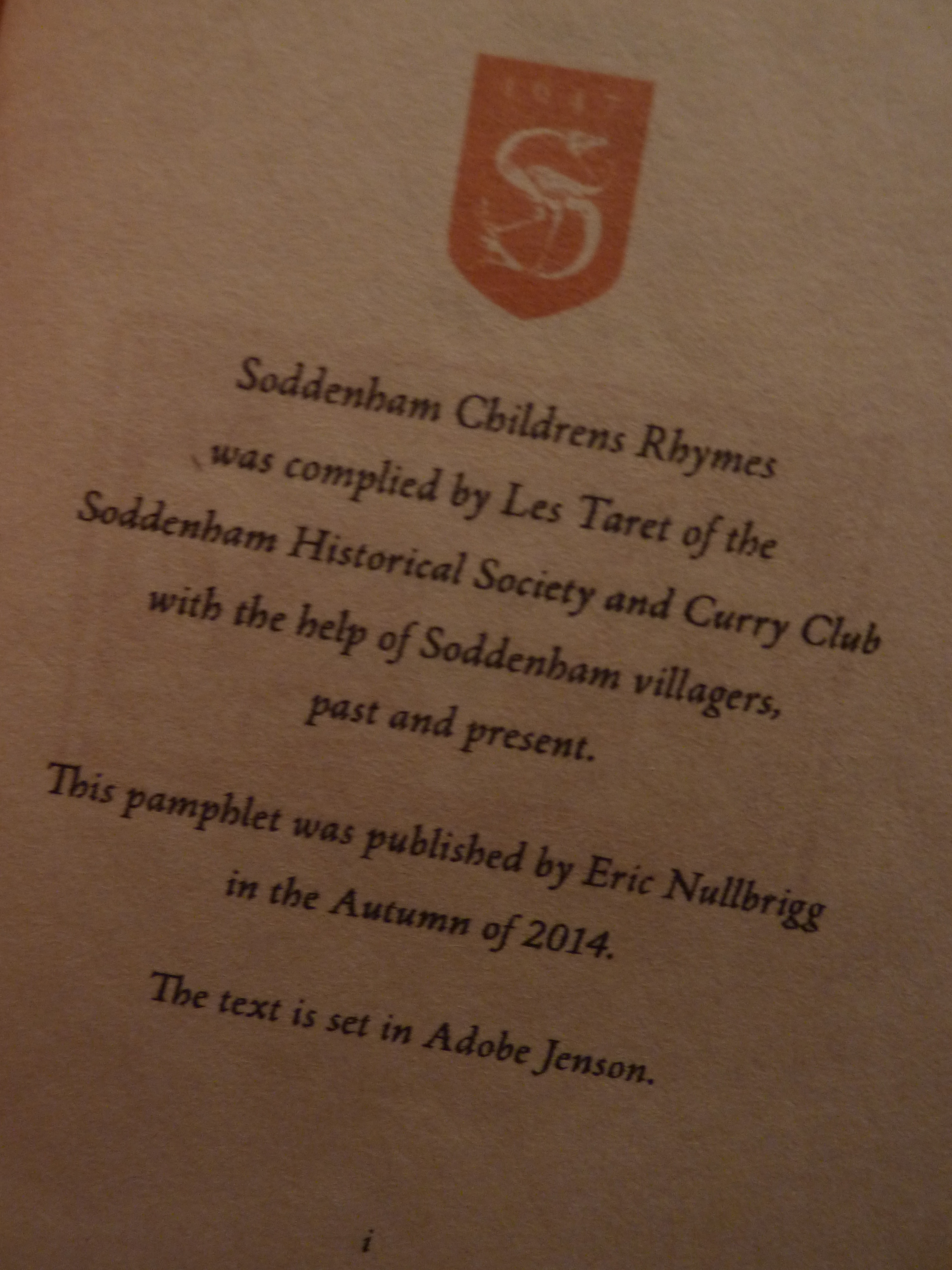
Yesterday I came home to find a small and peculiar brown paper package laying in my hallway, looking very out of place, otherworldly even, amongst the regular post. I carefully opened it to find my very own edition of the very same pamphlet courtesy of Mr Les Taret & Mr Eric Nullbrigg of the Soddenham Historical Society and Curry Club.

What a beautiful thing it is, too! Gorgeously tactile paper bound with linen cord, the ends of which have been dipped in red wax or dye? At least I hope it’s wax or dye! It’s certainly deep red in colour!!

P1010650

The contents are an assortment of children’s rhymes which have been, and possibly still are, popular amongst the children of the small Norfolk village of Soddenham. Many of these rhymes, as children’s rhymes tend to be, are of a rather sinister nature, pertaining often to the village’s troubled history with witchcraft.

To highlight the nature of the verse we also have a series of woodcut illustrations with suitably dark overtones.

P1010651P1010652P1010653

I also received an invitation to visit the village of Soddenham. I may well take them up on the offer at some point although I will try to avoid the major festival dates as I understand that some locals in villages such as this can get a bit excitable with their bonfires, especially with those outsiders that arrive ‘of their own free will’.

I will of course also practise thinking of brick walls. Just in case there are bands of fair-haired children with staring eyes roaming the streets. One can never be too careful.

If anyone else out there wishes to visit the small village of Soddenham then more information can be found here:

Click here to visit Soddenham

When Churchyards Yawn, Arrow 1963 (ed. Lady Cynthia Asquith)

A little about the title of my blog. It is, of course, a line from a writer whose work went a long way to shaping the modern horror story, William Shakespeare. Now, there was an author that could craft a chilling tale. If you consider the psychological horror of Macbeth, the serial killer thriller of Richard III, the ghost story of Hamlet or the out and out splatter-fest of Titus Andronicus you realise that Shakespeare was a genre writer through and through (…ok, he liked to do the odd rom-com too, but we’ll forgive him that).

I saw an RSC production of Titus Andronicus a year or so ago. So much blood!

So much blood!

The stage was awash with it, to the point of the bespattered audience members in the front row complaining to the management about the damage done to their clothes, not expecting a gentle evening of high culture to end in a veritable bloodbath.

So, back to the title of the blog. It comes from Hamlet:

Tis now the very witching time of night,
When churchyards yawn and hell itself breathes out
Contagion to this world: now could I drink hot blood,
And do such bitter business as the day
Would quake to look on.

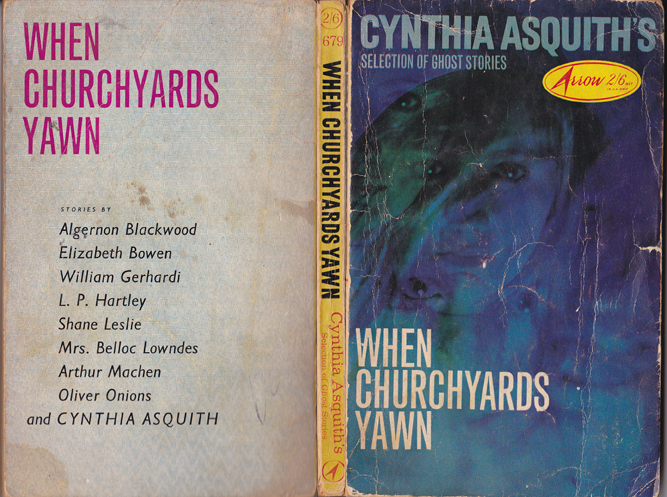
But, as much as I love Shakespeare, this is a blog about mid-20th century horror paperbacks so I didn’t choose the title from Hamlet but from this anthology of ghost stories edited by Lady Cynthia Asquith:

when churchyards yawn copy

Now then, this book isn’t actually from my own collection. Well, it sort of is….it sits on the shelves along with my collection. I’ve collected these horror paperbacks since I was around 10 years old. They fascinated me. I would pick them up from jumble sales whenever I found them (…or whenever I could afford them (times were ‘ard back then)).

Anyway, skip forward ten years or so and I met the girl who was to become my wife. When I first walked into her bedroom her bookshelf stared me in the face…Peter Haining, Dennis Wheatley, Pan Horror, Fontana Ghosts…she had been collecting them since her childhood too! So this book rightly belongs to my wife, Samantha.

I’ve just read that paragraph back to myself. A young man walks into the bedroom of a young lady for the first time and all he can do is obsess about her bookshelf………and that’s not even a euphemism! Well, you play the hand you’re dealt, I suppose.

Contents

The Apple Tree – Elizabeth Bowen

A Little Ghost – Hugh Walpole

The Cotillon – L. P. Hartley

The Buick Saloon – Ann Bridge

A Threefold Cord… – Algernon Blackwood

Opening the Door – Arthur Machen

As In a Glass Dimly – Shane Leslie

The Horns of the Bull – W. S. Morrison

The Man Who Came Back – William Gerhardi

The Unbolted Door – Mrs. Belloc Lowndes

“John Gladwin Says…” – Oliver Onions

Our Feathered Friends – Philip MacDonald

“God Grante That She Lye Stille” – Cynthia Asquith


Edited by Lady Cynthia Asquith, this anthology was first published in hardback form by Hutchinson in 1931 and the stories included, although appearing in many anthologies in the following decades, would mostly have been first published here. It’s a classy line-up, Asquith usually stuck with a similar list of authors for her anthologies and, why not? When you can have a contents page like this, why go elsewhere?

The highlights of this anthology for me are The Cotillon by L. P. Hartley and Our Feathered Friends by Philip MacDonald.

Hartley is a master of portraying the dangerous subtext within passionate relationships, as in his novel The Go-Between, and he doesn’t disappoint here in this wonderfully gothic tale set during a masked dance in the middle of winter. 78 masked guests should be present at the dance but, after a sash window is discovered open with the snow blowing in, a 79th masked guest has arrived!

MacDonald offers a very simple tale but tells it in such a hypnotic way it can’t fail to draw the reader in. MacDonald has a very cinematic writing style and uses it well here, at the opening of the story the reader is viewing the two characters as small parts in a panoramic landscape and as the tension increases he slowly pans us in closer and closer until we’re right on top of the action at the gruesome denouement.

For anyone out there that’s new to early to mid-20th century supernatural fiction, you could do a lot worse than getting hold of Lady Cynthia’s anthologies. She breaks no new ground here, most of the authors are well established in their writing careers, but it is a good solid read nonetheless.

Supernatural, Fontana 1977, (Robert Muller)

As part of their Gothic season the BBC are repeating their 1977 supernatural drama series tonight, imaginatively titled Supernatural.

A series of independent stories linked by a wonderful premise, in the style of the Amicus portmanteau films. The premise here is a Victorian club called The Club of the Damned, to gain entry a prospective member must tell the members a terrifying tale. If it is not considered scary enough then not only is the prospective refused membership but he is put to death.

Sounds great, doesn’t it? Sadly the whole thing is rather mediocre, poor direction, stilted dialogue and those very mannered performances that the BBC thought was the way everyone acted who existed before the 20th century.

As was the fashion in the 1970s they published a novelisation (although, as it’s not a novel in the common sense of the word, perhaps a short-storyisation would be a better description?)

Published in 1977 by Fontana, the seven stories are adapted from Robert Muller’s screenplay by a selection of authors, including the prolific Rosemary Timperley who had many stories in the Pan horror anthologies.

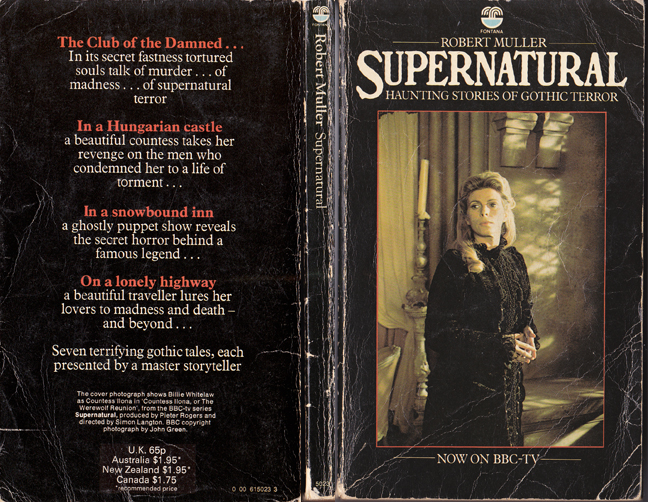
Anyway, I pulled the book off my shelf when I saw the tv series was being repeated, it usually lurks in the arse-end of my collection. Here’s the cover, showing the wonderful Billie Whitelaw, who was married to the writer Robert Muller:

supernatural

Who Fears the Devil? Star Books 1975 (Manly Wade Wellman)

Who fears the Devil? says Jane unto Jim,
Who fears the Devil? says Jim unto Joan,
Who fears the Devil? says Jane unto John –
Not I! Not I! says John all alone.

~from a game song, once popular with Southern children

This is the epigraph to Manly Wade Wellman’s first collection of short stories concerning his enigmatic protagonist John (sometimes known as Silver John or John the Balladeer), a wandering, folk-singing, backwoodsman, folklorist kind of a guy who travels the Appalachians battling evil with his silver-stringed guitar.

Ok, I’ll be the first to admit that the premise sounds a bit daft, a bit like one of those American serials they used to show on ITV of a Saturday evening where the lone hero wanders from town to town getting himself into all sorts of scrapes and never finding peace. Think The Incredible Hulk, Highway to Heaven or The Littlest Hobo……..NO, stop it! Don’t think of those, this is much better!

Wellman was a long time, and very popular, contributor to genre magazines Weird Tales, Astounding Stories etc. etc. In the 1950s he moved from New York (where he wrote his fictional hero John Thunstone, a Manhattan playboy occultist) to the small town of Pine Bluff in North Carolina. Having a lifelong interest in the esoteric and folk magic, here he immersed himself in southern history, folklore and folksong to create the stories about John.

The stories in this collection all appeared in magazines during the ‘50s and were first published as a collection in 1963 by Arkham House. The first paperback edition came from Star Books in 1975. Let’s have a look at the cover shall we?
I’ve no idea who created the artwork for this (…if anyone does know then I’d love to hear from you). Just look at that demonic figure trapped behind the guitar strings! Do you recognise him?

who fears the devil cover

Go on, look a bit closer.

Anything yet?

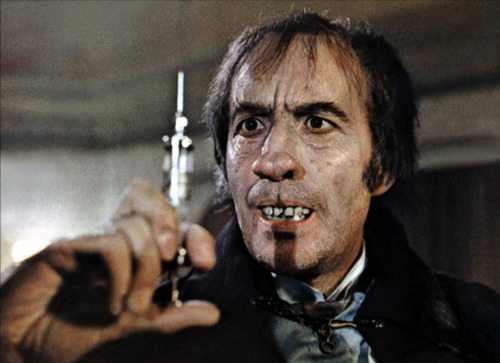
It is, or course, a blatant copy of Christopher Lee’s character Edward Blake from ‘I, Monster’, the 1971 Amicus loose adaptation of Jekyll and Hyde. Here he is:

I, monster 1i, monster 2

Anyway, down to the contents. The eleven stories proper are each prefaced by an atmospheric little half page italicised vignette.

John’s My Name
O Ugly Bird!

Why They’re Named That
One Other

Then I Wasn’t Alone
Shiver in the Pines

You Know the Tale of Hoph
Old Devlins Was A-Waiting

Find the Place Yourself
The Desrick on Yandro

The Stars Down There
Vandy, Vandy

Blue Monkey
Dumb Supper

I Can’t Claim That
The Little Black Train

Who Else Could I Count On
Walk Like a Mountain

None Wiser for the Trip
On the Hills and Everywhere

Nary Spell
Nine Yards of Other Cloth

Most of these stories are written in first person from John’s perspective, so they’re full of a warm Appalachian dialect. Wellman judges the use of language well, never overdoing it to the point of parody. He creates a subtle and believable world for John to traverse; strange and dreamlike it is a world of tall mountains, bottomless pools and dark pinewoods; it is filled with hoodoo men, witches and double-dealers. The landscape is a dangerous place of ‘scarced-out’ animals with folknames, like The Toller, The Flat, The Skim and The Behinder (so called because it always gets people from behind and, as such, no one has ever seen it (‘cepting John, of course)).

Wellman subtly mixes fact with his fiction to lend a plausibility to the fantastic. John sings real songs and Wellman includes snippets of lyrics to add depth and atmosphere, including the wonderful ‘In the Pines’ (here’s the famous version from Leadbelly):

Historical figures exist alongside fictional ones, such as in the Hatfield and McCoy feud sequence in ‘Old Devlins was A-Waiting’. In this story Wellman also introduces us to ‘real’ magical practices with the inclusion of a ritual with the Sator Square. The magic in this world is primitive sympathetic folk magic and the shamanistic feel is mirrored in the natural world vividly described, even the creatures are described in terms of natural objects. When we first see the monster known as One Other his “…shoulder was like a cypress root humping out of the water, the head was like a dark pumpkin”. The monsters were there before humans so, in effect, they are a part of nature and, as many folk tales stem from warnings about the natural world, this is quite fitting.

When it comes to the human characters John meets through these tales Wellman paints the world in black and white. All the good men are honest, hard-working, poor-but-contented types and we know the bad men as their inner traits are exposed by their physical ugliness. The women are either pretty innocents waiting to be rescued from the bad men or glamorous femme fatales waiting to entrap the good men. There’s no room for ambiguity with his characterisation but Wellman does have a wonderful knack of describing each new player with a Chandleresque precision. A favourite of mine is from The Desrick on Yandro:

“His buckskin hair was combed across his head to baffle folks he wasn’t getting bald. His round, pink face wasn’t soft, and his big, smiling teeth reminded you there was a bony skull under that meat. His pale eyes, like two gravel bits, prodded me and made me remember I needed a haircut and a shine.”

For all the curses, monsters and supernatural terror in Wellman’s tales the biggest evil of all is money, or at least a love of money. The villains are invariably wealthier than their victims and the only real use for a silver coin in this world is to ward off evil. And if you see a feller that’s flashy enough to be carrying gold well, gentlemen, you can bet he’ll have them hellhounds a-snapping at his heels.

And to finish with a song, Wellman dedicated his book to his friend the folksinger and folklorist, Bascom Lamar Lunsford (among others) and even referred to him by name in Old Devlins was A-Waiting. Here he is performing Dogget’s Gap. Look at this scene and imagine a tall stranger with a silver strung guitar slung on his back walking out of the woods and joining the song and you’ve got the start of a Who Fears the Devil story right there:

Afterthought

There’s a fair bit of old-time religion in these pages, as you’d expect from good old god-fearin’ folk, but the penultimate tale ‘On the Hills and Everywhere’ is an awful, saccharine parable and  how it got past a submissions editor I just can’t imagine.